Agrimony
Agrimonia eupatoria
A meadow rose-family herb whose dried flowering tops smell faintly of apricot. Folk European teas used the aerial parts as a mild astringent; it is not a salad green.
GROW → HARVEST → EAT → DRY → POWDER → CAPSULE → GUMMY — forms are not equivalent. Food first.
Identity
Also called: church steeples
What it is
A meadow rose-family herb whose dried flowering tops smell faintly of apricot. Folk European teas used the aerial parts as a mild astringent; it is not a salad green.
Identification
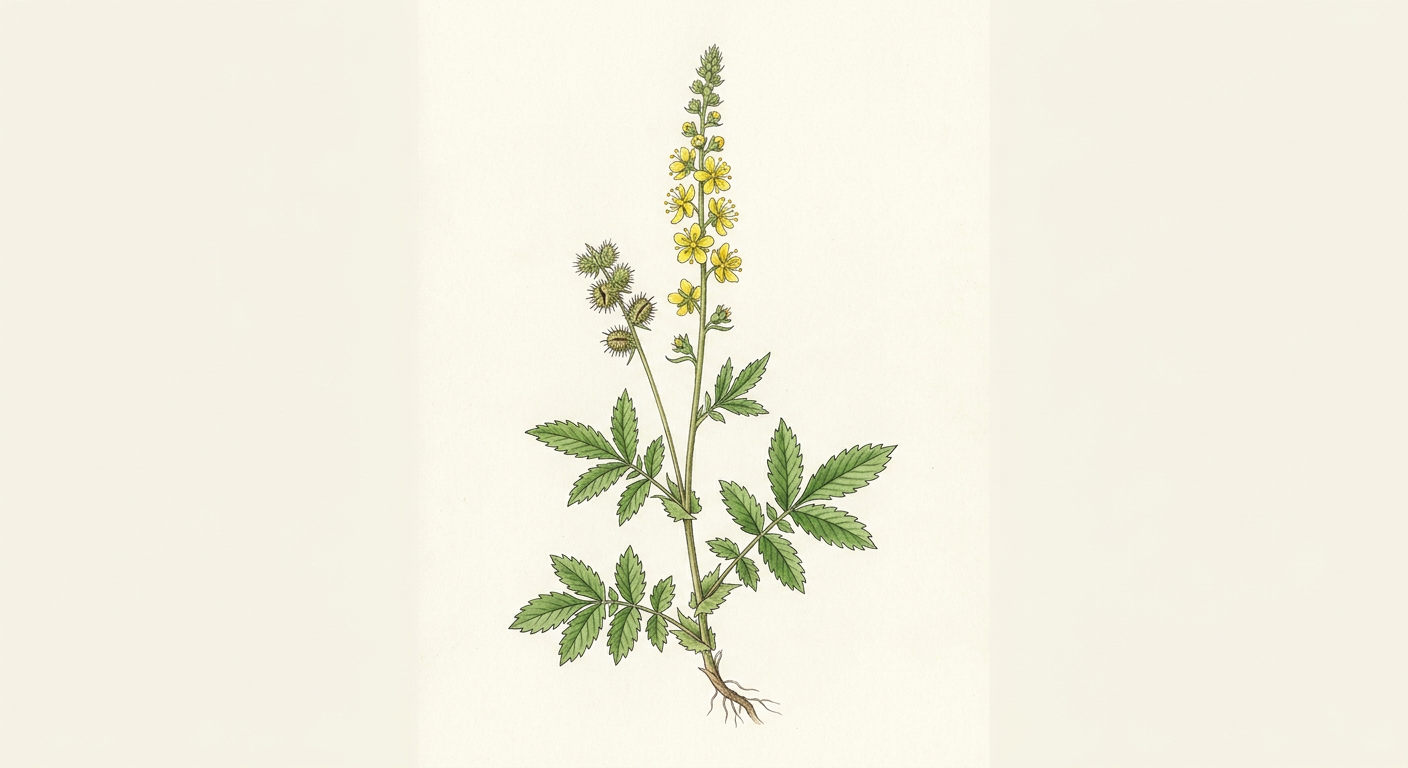
Yellow five-petaled flowers on a slender spike; leaves pinnate with a toothed terminal leaflet.
From the existing encyclopedia
Agrimony is a meadow herb whose aerial parts were traditionally steeped as a mild astringent tea in European folk practice. The dried leaves and flowers carry a faint apricot-like scent that blends well with other digestive bitters in tea blends. In the pantry, agrimony is sold as cut-and-sifted dried herb for infusions, not for internal use in concentrated extracts without professional guidance. Pair with chamomile or mint for balanced evening teas; store airtight away from sunlight.
Edible portions
- aerial parts as tea herb
Absence of a portion from this list means it is not treated as food here — not that every other part is toxic.
Growing
- Climate. 5–8
- Light. Full sun to light shade
- Soil. Average, well-drained; tolerates lean meadow soil
- Planting. Sow on the surface; needs light to germinate. Perennial clumps from a woody crown.
- Harvest. Cut flowering stems as blooms open; dry in bunches out of sun.
Processing, drying, storage
- Drying. Hang small bunches until brittle; crumble leaves and flowers, discard coarse stems. See also Make → Drying.
Preparation and culinary uses
- Traditional infusion with mint or chamomile — culinary-tea amounts only
Traditional uses
Traditional use European folk astringent tea
AAA interpretation Traditional use is not automatically evidence, and evidence is not automatically a shopping recommendation.
Next steps
Sources
- USDA PLANTS Database — taxonomy and range (verify current entries)
- No USDA FoodData Central nutrient profile is attached here. That is not a claim that the plant contains no nutrients.
- State cooperative extension growing guides — verify for your region
- Integrated from the existing aaaLifetime / quantum-biohack encyclopedia corpus (unique text preserved where it was not boilerplate).
Honest incompleteness is preferred to fabricated completeness. If a section is missing, no record for it is attached here — not a claim that the plant lacks that characteristic, and not that it was omitted as a secret.
Internal quality class A. Strong page: distinctive plant facts plus practical growing or kitchen use.