Feverfew
Tanacetum parthenium
A small daisy-leafed perennial that smells of camphor when crushed. Traditional headache-leaf folklore exists; this site does not treat it as a dosing protocol. Bitter, not a salad herb.
GROW → HARVEST → EAT → DRY → POWDER → CAPSULE → GUMMY — forms are not equivalent. Food first.
Identity
What it is
A small daisy-leafed perennial that smells of camphor when crushed. Traditional headache-leaf folklore exists; this site does not treat it as a dosing protocol. Bitter, not a salad herb.
Identification
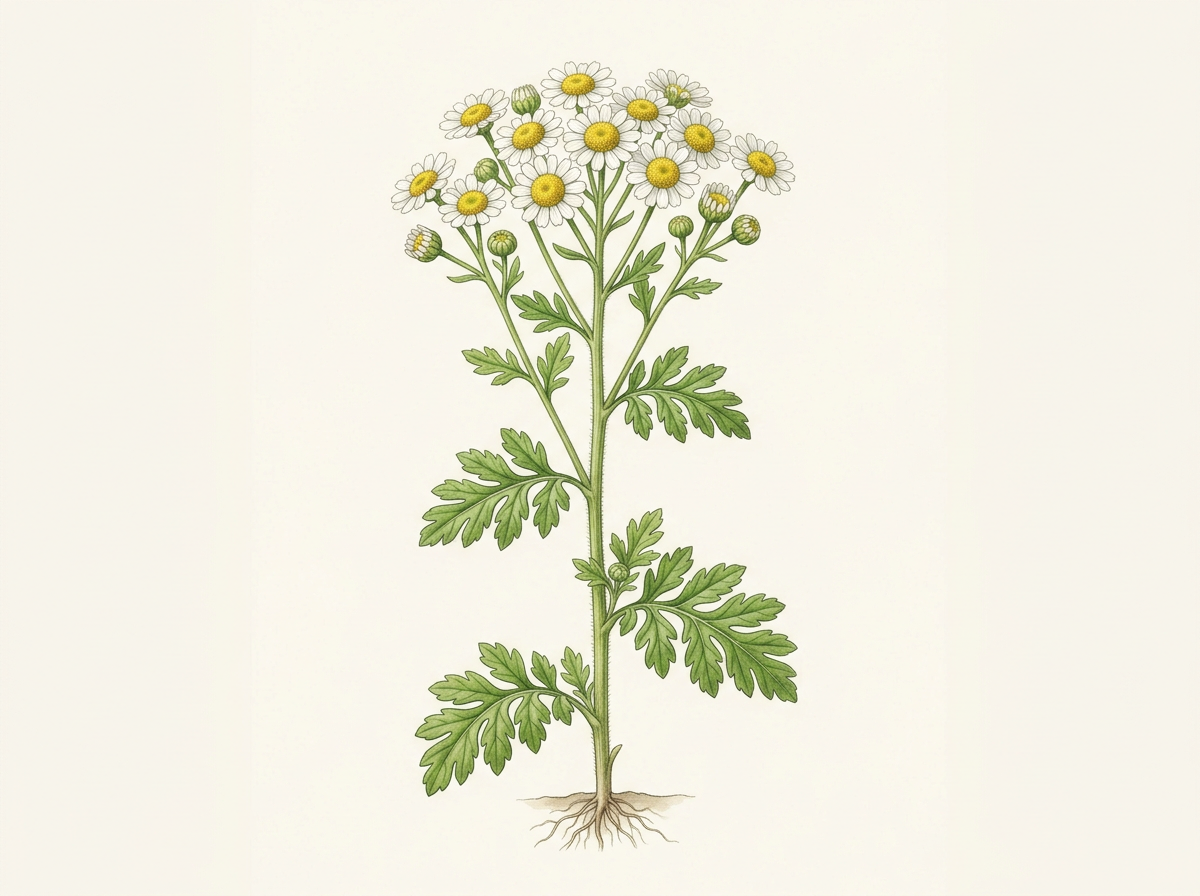
Pinnate chrysanthemum-like leaves; small white daisies with yellow disks.
From the existing encyclopedia
Feverfew shows up in regional spice blends, apothecary tea chests, and slow-cooked pots where aroma matters as much as flavor. Toast whole seeds briefly in a dry pan to wake volatile oils before grinding. Balances with honey or dates in warm drinks when used as food sweetening. When substituting dried Feverfew for fresh, use about one-third the volume and bloom in fat or hot water before adding acid or dairy.
Edible portions
Safety Not treated as food on this site.
Growing
- Climate. 5–8
- Light. Full sun
- Soil. Well-drained
- Planting. Easy perennial; can self-sow.
Traditional uses
Traditional use Folk migraine leaf — traditional claim, not a clinical instruction
AAA interpretation Traditional use is not automatically evidence, and evidence is not automatically a shopping recommendation.
Safety
- Bitter medicinal herb, not food. Chewing leaves can cause mouth irritation. Not a children’s tea.
Next steps
Sources
- USDA PLANTS Database — taxonomy and range (verify current entries)
- No USDA FoodData Central nutrient profile is attached here. That is not a claim that the plant contains no nutrients.
- State cooperative extension growing guides — verify for your region
- Integrated from the existing aaaLifetime / quantum-biohack encyclopedia corpus (unique text preserved where it was not boilerplate).
Honest incompleteness is preferred to fabricated completeness. If a section is missing, no record for it is attached here — not a claim that the plant lacks that characteristic, and not that it was omitted as a secret.
Internal quality class B. Good foundation: enough unique information to exist as its own destination.