Rooibos
Aspalathus linearis
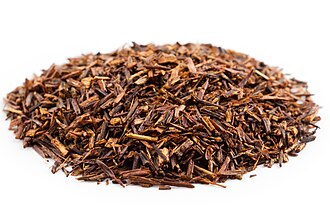
A South African fynbos shrub. The red tea is fermented/oxidized needle leaves; green rooibos skips that. Caffeine-free relative to Camellia. Not a temperate garden plant for most people.
GROW → HARVEST → EAT → DRY → POWDER → CAPSULE → GUMMY — forms are not equivalent. Food first.
Identity
Also called: red bush
What it is
A South African fynbos shrub. The red tea is fermented/oxidized needle leaves; green rooibos skips that. Caffeine-free relative to Camellia. Not a temperate garden plant for most people.
Edible portions
- processed leaves as a beverage
Absence of a portion from this list means it is not treated as food here — not that every other part is toxic.
Growing
- Climate. Mediterranean South Africa — not a typical U.S. hardy shrub
- Light. Full sun, dry summers in origin
- Soil. Sandy, acid, well-drained
- Planting. Buy dried tea. Growing it outside fynbos is a specialist project.
- Harvest. Needle leaves, then bruise/ferment for red, then dry.
Processing, drying, storage
- Processing. Oxidation is a choice (red vs green rooibos), analogous to tea’s green/black fork but a different species.
Preparation and culinary uses
- Caffeine-free infusion
Next steps
Sources
- USDA PLANTS Database — taxonomy and range (verify current entries)
- No USDA FoodData Central nutrient profile is attached here. That is not a claim that the plant contains no nutrients.
- State cooperative extension growing guides — verify for your region
Honest incompleteness is preferred to fabricated completeness. If a section is missing, no record for it is attached here — not a claim that the plant lacks that characteristic, and not that it was omitted as a secret.
Internal quality class B. Good foundation: enough unique information to exist as its own destination.