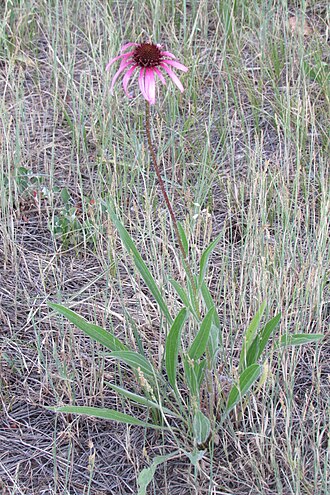
Narrow-leaf echinacea
Echinacea angustifolia
Prairie species used in some herbal markets more than E. purpurea. Still a coneflower, still not an immune mandate. Conservation: don’t wild-dig.
GROW → HARVEST → EAT → DRY → POWDER → CAPSULE → GUMMY — forms are not equivalent. Food first.
Identity
What it is
Prairie species used in some herbal markets more than E. purpurea. Still a coneflower, still not an immune mandate. Conservation: don’t wild-dig.
Edible portions
- petals as garnish
Absence of a portion from this list means it is not treated as food here — not that every other part is toxic.
Growing
- Climate. 3–8 prairie
- Light. Full sun, dry
- Soil. Well-drained, lean
- Planting. Harder than E. purpurea. Deep taproot.
- Harvest. Don’t wild-harvest roots.
Traditional uses
Traditional use Herbal market species — traditional/supplement use
AAA interpretation Traditional use is not automatically evidence, and evidence is not automatically a shopping recommendation.
Supplement relevance
AAA interpretation Products may mix species. Growing a prairie plant is not a standardized extract.
If you are considering a bottle, use the food-first tools rather than a social-media urgency loop.
Next steps
Sources
- USDA PLANTS Database — taxonomy and range (verify current entries)
- No USDA FoodData Central nutrient profile is attached here. That is not a claim that the plant contains no nutrients.
- State cooperative extension growing guides — verify for your region
Honest incompleteness is preferred to fabricated completeness. If a section is missing, no record for it is attached here — not a claim that the plant lacks that characteristic, and not that it was omitted as a secret.
Internal quality class B. Good foundation: enough unique information to exist as its own destination.